Thứ Tư, 9 tháng 11, 2005

Robert Young Pelton on Dangerous Places


Drowning NOT Waving

Always some great fun at the website of Robert Pelton Young, which he cheerfully calls Come Back Alive.

I first met Robert at the Book Expo in Los Angeles many years ago while I was promoting the first edition of my Southeast Asia Handbook for Moon Publications. Robert had purchased venerable yet deathbed ridden Fielding's guides and was cranking out new editions and updates at a furious pace.

I picked up a copy of Robert's guide to Borneo, sensibly called Fielding Borneo with a pub date of 1995. Fielding guides later folded, but Bob went on to interviews in Iraq and hooking up with kids in Marin for adventures in Panama and beyond.

He lives in a world of trouble.

My kinda guy.

The Airplane House in Ventura County


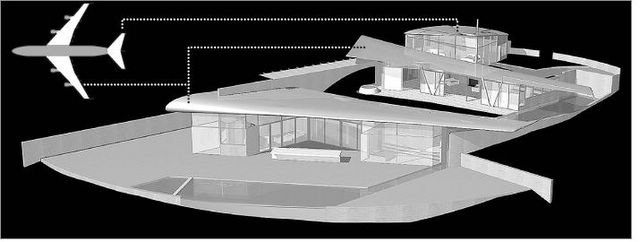
Airplane House Overview


Airplane House Side View


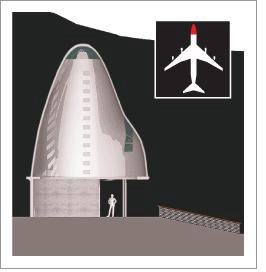
Airplane House Meditation Cone

A lady in Ventura County, near Los Angeles, intends to construct her new home from one of those abandoned airplanes that lay in suspended animation out in the Mojave Desert. I congratulate the ingenuity of her architect, who studied her passions and came up with this highly original idea.

If it doesn't work out, she could always move elsewhere and turn this museum house into yet another quirky California tourist attraction and collect $20 a pop per visit, or several hundred bucks to overnight. Wouldn't you pay this to experience something this outlandish?

God bless California.

West Coast Woman To Build Crash Pad Out of an Old 747
By ALEX FRANGOS
THE WALL STREET JOURNAL
November 5, 2005


VENTURA COUNTY, Calif. -- Francie Rehwald wanted her mountainside house to be environmentally friendly and to be "feminine," to have curves. "I'm a gal," says the 60-year-old retiree.

Her architect had an idea: Buy a junked 747 and cut it apart. Turn the wings into a roof, the nose into a meditation temple. Use the remaining scrap to build six more buildings, including a barn for rare animals. He made a sketch.

"When I showed it to her in the office, she just started screaming," recalls the architect, David Hertz of Santa Monica. Ms. Rehwald, whose passions include yoga, organic gardening, meditation, folk art and the Cuban cocktails called mojitos, loved the adventurousness of the design, the feminine shapes and especially the environmental aspect.

"It's 100% post-consumer waste," she says. "Isn't that the coolest?"

A meditation chamber will be one of the buildings assembled from an old jet.

Unusual homes are nothing new along the coast of Southern California, long a magnet for eccentrics and free spirits. The "cyclotron house" in Malibu is shaped like an atom smasher. The "eyeball house" in Woodland Hills is a wooden silo with four giant glass eyes affixed to it. The "Chemosphere" looks like a flying saucer perched on a toothpick at the edge of a cliff in the Hollywood Hills.

Ms. Rehwald, whose family founded the first Mercedes-Benz dealership in southern California, is intent on adding to the genre. She has reserved a junked jet to purchase, charmed local planning officials and spent $200,000 on consultants.

"I am as much a part of this world as a bird, the frog in the creek," says Ms. Rehwald, who used to work at the family dealership, of her environmental motives. She wears a white sailor's hat perched atop her tossled blond hair, and her gold and silver bracelets jangle as she speaks. "This is my antidote to the malling of America."

Mr. Hertz has designed homes for such boldface Hollywood names as Julia Louis-Dreyfus of Seinfeld fame. He says his aeronautical inspiration struck after a long flight from Los Angeles to Scotland. The 747, he says, "though designed in the 1960s, is still an absolutely beautiful contemporary object. It was derived from pure function."

Mr. Hertz isn't the first architect to find inspiration in aeronautics, and people have turned grounded airplanes -- small ones at least -- into makeshift homes before. But Mr. Hertz may well be the first to propose building a high-end home with pieces of a 747.

First, Mr. Hertz had to find a plane. New 747s start at more than $200 million. He called Mark Thompson of Aviation Warehouse, who runs an airplane junkyard in the California desert that resembles the futuristic wasteland of "Mad Max." Mr. Thompson told him that $70,000 to $100,000 would buy Ms. Rehwald a decommissioned Boeing 747-200 that still carries the faded logo of defunct Tower Air. Half the value was in the ailerons, the moveable parts of the wing. Mr. Hertz figured he could use them to control the awning on the patio by Ms. Rehwald's swimming pool.

Mr. Thompson met with county engineering officials to persuade them that the jet parts could withstand the strong winds that sometimes buffet Ms. Rehwald's property. "It's difficult to get a city engineer who is used to working with 2-by-4s and plaster to realize that an airplane that flies 500 miles per hour can stand up to 40-mph winds."

The salvaged wings and tail flaps of a Boeing 747 will serve as the roof for this multilevel country home in California, as seen in an architect's renderings from the front (above) and the side.

Nancy Francis, supervisor of the residential permits section at the Ventura County Planning Division, says she's excited such an unusual dwelling is going up in her jurisdiction. "Everyone in the department wants to go on the site visit when it's done," she says.

A winding one-lane road leads to the sunny hillside in the Santa Monica Mountains where Ms. Rehwald intends to create her architectural oddity. The 55-acre plot with views of the Pacific, now covered in aloe, agave cactus and white oleander flowers, is one hour north of L.A. It once housed dozens of buildings erected by Hollywood designer Tony Duquette, who built with found objects and industrial garbage such as old tires and radiators. A fire in 1993 destroyed most of his strange handiwork. Ms. Rehwald bought the land last year.

Mr. Hertz and his assistants have been spending time in the desert with the derelict jet, measuring it with long pieces of string and contemplating its shapes. Eventually, he and Mr. Thompson will cut it into pieces and truck it to a valley near his client's property. He figures it will take a helicopter 10 hours -- at $8,000 an hour -- to ferry the metal chunks up the hillside.

There he intends to assemble a compound of buildings connected by narrow dirt paths. The jet's wings will rest on thick concrete walls, forming the roof of a multilevel main house. The nose will point to the sky, becoming a meditation chamber, with the cockpit window a skylight. The first-class cabin will be an art studio. The signature bulge on the top of the 747 will become a loft. A barn will house rare domestic animals such as the poitou donkey. A yoga studio, guest house and caretaker's cottage will round out the compound.

"We are trying to use every piece of this aircraft, much like an Indian would use a buffalo," says Mr. Hertz.

He says the eight buildings will be scattered across the terraced hillside as if it were a "crash site." As it happens, the site lies under a jet flight path into Los Angeles International Airport. That concerns the Federal Aviation Administration, which has asked Mr. Hertz to paint special numbers on the wing pieces to alert pilots that Ms. Rehwald's retreat is not a crashed jumbo jet.

In deference to neighbors such as Dick Clark and the former spouses of Bob Dylan and Olivia Newton-John, the structures will keep a low profile, blending into the land, says Mr. Hertz. He intends to "bioblast" the metal with walnut shells to remove the Tower Air paint and dull the sheen.

Ms. Rehwald says she has given Mr. Hertz a $1.5 million budget. She promptly adds: "I'll be real fortunate if it's less than $2 million."

He has already spent money on an archeologist to look for Chumash Indian artifacts and a biologist to tell her how best to manage the coyotes, mountain lions and rattlesnakes that traverse her land. She hopes to start construction within nine months, and to move in by 2007. Until then, when Ms. Rehwald visits the site, she stays in a Winnebago trailer borrowed from a friend.

The Wall Street Journal Link

Boeing 777 Sets New World Record

My first long airplane ride dates from 1959 when my family took an Air Force cargo junker from Travis A.F.B. to Yokota, Japan, with stops in Honolulu and Wake Island. The propeller plane shaked the entire 36 hours and nobody enjoyed the steel seats bolted to the steel floor, but that was Air Force transport in the day.

I also didn't appreciate the fact that candy bars cost 10 cents on Wake Island, and only five cents back home.

Boeing has just set another record for the longest continual, direct, non-stop commercial flight in the world with their 777 blazing across the skies from Hong Kong to London. Longer flights with additional fuel tanks bolted are anticipated.

But will they pass out valiums to the passengers?

Boeing plane takes off on 23-hour nonstop flight
By Dominic Gates
Seattle Times aerospace reporter
Nov 9, 2005


Aiming for a new distance record for a commercial jet, Capt. Suzanna Darcy-Hennemann took off in a twin-engine Boeing 777-200LR from Hong Kong this morning on a nonstop flight to London — the long way around. The eastbound, 23-hour flight across the Pacific, the continental United States and the Atlantic will cover at least 12,500 nautical miles.

The airplane was slated to carry about 35 passengers and crew, including Boeing executives, journalists, pilots from Pakistan International Airlines and Singapore Airlines, and representatives from the General Electric division that makes the engines. Three other senior Boeing test pilots — Frank Santoni, John Cashman and Randy Austin — will also take turns at the controls.

The airplane is a standard version of the new ultra-long-range jet, which will enter service with Pakistan International early next year. Boeing also offers the airplane with auxiliary fuel tanks that would expand its range even further, though no airlines have yet ordered the model with extra tanks.

Australian carrier Qantas is considering a version with six extra tanks that could fly a regular service nonstop between London and Sydney.

For now, Airbus can still boast of flying the longest nonstop regular commercial air service. Singapore Airlines operates the four-engine A340-500 daily between Singapore and New York, an 18-hour flight covering 9,000 nautical miles. But the airline is also weighing an order for the Boeing jet.

Seattle Times Link

Tokyo on $2 Per Day


Geisha with Cell

This stuff happens sometimes even with the big boys of travel bookings such as Expedia or Travelocity, or major airlines such as United or Icelandic, which last year offered round-trip tickets to Iceland for just $39. Mistakes. Some tired programmer or data underling late at night just puts the wrong prices on the website.

A goose egg often honored by major websites, even though everybody recognizes that it was just an honest mistake. Still, it's great fun and the publicity is probably worth honoring some of these outrageous deals.

Recently, Expedia screwed up on their hotel listings in Japan and offered rooms in first-class Hiltons for just a few bucks. They intend to honor all reservations made for the month of November, but the guy who reserved a room for an entire year is just out of luck.

The story is then followed by a snippet about an ingenious way to save money on accommodations in China including Shanghai: spend the night on a cot in a bathhouse with plenty of available extras. That actually sounds excellent to me.

Asia for $10 a night (and less)
USA Today
Hotel Hotsheet
Megg Schulte
Nov 9, 2005


Sleeping on the super-cheap just became a wacky reality. From China's bathhouse hotels that offer the barest definition of sleeping accommodations to a snafu on Expedia for hotels in Japan, this week is all about scoring a deal in Asia.

If you had excellent timing last weekend, you might be one of the incredibly lucky folks who booked rooms at the Hilton Osaka and Hilton Tokyo hotels. A number of readers wrote to say they were alerted to a mistake on Expedia that allowed rooms to be booked at those two properties for between $2 and $4 a night.

Charles Bu, a math professor at Wellesley College in Mass., scored a week in Osaka in April and two weeks in an executive floor king room in August at the bargain rate of $3.55 a night, plus tax. Including free breakfast and Internet access, his one-week stay tops out at $33.52. I just tried to book this same room, same days, and the total? About $2,443.00, Bu notes the trouble seems to be Expedia's currency conversion rate, and it doesn't take a mathematician to see they definitely had a problem.

Flyertalk.com's message boards are filled with reader postings on the "sale." One man even claims to have booked rooms for an entire year at the Hilton Tokyo; now he's trying to find a job to go along with his new "home."

Alas, when things sound too good to be true, they often are. We asked Expedia whether they would honor these reservations. According to spokesman David Dennis:

"A pricing error occurred on Friday night, and rooms at two Hilton International hotels in Japan were advertised at the wrong price due to an isolated processing incident. As soon as the error, which was obvious to consumers, was noticed, it was immediately rectified.

"Expedia and Hilton stand behind consumers. And to resolve this episode in a fair and equitable way, the following solution has been reached:

"If a booking was made for the month of November, Hilton will honor the reservation at the quoted price. But if a booking was made for December or beyond, it will be cancelled – unless it is part of a package, which Expedia.com will honor."

Now it's your turn: Do you think Expedia and Hilton are acting in 'a fair and equitable way' by honoring part of the bookings made? Or do you think all bookings should be honored? I'd like to hear your thoughts, so e-mail me at travel@usatoday.com and I'll post a follow up in next week's column.

Sleep on a chair, save a bundle

The Japanese capsule hotels have been around a while now, but now we have Chinese bathhouses getting into the lodging business. For about $10 a night, you get a hot shower, a recliner to sleep in, breakfast and a massage, The Wall Street Journal (free story) reports. One female marketing executive, after balking at the super-high hotel prices in Shanghai, chose the recliner route on a recent trip. "It gets noisy, but it is still a bargain," she said.

Once the bastion of business men in need of a soak, bathhouses are morphing into cheap accommodations, with some even offering entertainment options (think arcades Â… this is a family publication) and even swimming pools.

I'm not sure how this would go over in the U.S. where personal space is almost a requirement, but I bet there could be a market for it in NYC, where hotel rates are once again astronomical.

USA Today Link

Thứ Năm, 20 tháng 10, 2005

RU Turisto or Earth Lovin' Traveler?


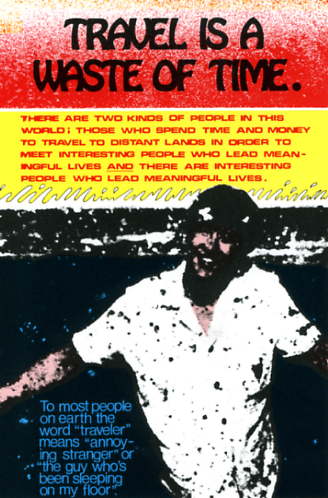
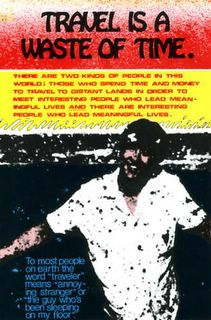
Travel is a Waste of Time

One of the travel world's most quaffed talking points has again resurfaced after decades buried under the concrete of tired and trite travel industry cliches. Frankly, I thought this discussion was dead, but last weekend, John Flinn at the San Francisco Chronicle goes over that eternally fascinating question: are you a tourist or a traveler? I guess John was bored gazing out the window of his plush office in the 69th floor of the Chron, or perhaps the editors decided that the "new generation" hadn't gone through this hoop.

Or is it a loop?

Whatever. Here it is again.

I'm a Tourist
You're a Tourist
Let's All be OK with That
John Flinn
San Francisco Chronicle
Oct 16, 2005


"Tours for travelers, not tourists" is the slogan of a tour company whose brochure landed on my desk a while back. This stuck me as a pretty nifty little Zen koan. Tours that aren't for tourists, I gather, are roughly equivalent to bicycles that aren't for bicyclists and flutes that aren't for flutists.

I hate to shatter anyone's cherished prejudice, but here's the definition of "tourist" in Webster's New World Dictionary: "a person who makes a tour, esp. for pleasure." Which means that if you go on a tour -- even one operated by this particular company -- you are, by definition, a tourist.

Not that there's anything wrong with that.

But among the status-conscious, the word "tourist" has come to mean "anyone who travels in a style I consider inferior to the way I like to think I do it."

You can't open a glossy travel magazine or click on a Web page these days without tripping over one of those tiresome aphorisms: A tourist travels to get away from home; a traveler feels at home when he travels. A traveler sees what he sees; the tourist sees what he has come to see. A traveler makes his own way; a tourist has another make his way for him. A tourist takes his prejudices with him; a traveler is transformed by his journeys. A tourist comes home with photos; a traveler comes home with memories.

In other words: A traveler like me is cool; a tourist like you is a dork.

The travel media loves to promote this bogus dichotomy. "Be a traveler, not a tourist," is the slogan on ads for "Without Reservations," a new show on the Travel Channel, as writer Rolf Potts pointed out recently on his blog. The very same tagline is on the cover of a guidebook series published by Open Road and was, for a while, the name of a column in National Geographic Traveler magazine.

If there really is that big a gap between travelers and tourists, I truly doubt you're going to bridge it by choosing one mass-market guidebook over another or watching a half-hour show wedged between Texas Hold 'Em tournaments on the Travel Channel.

The problem, I think, is that it's gotten so much harder for status-conscious travelers to feel superior. A generation or two ago, merely stepping onto an airplane or a train or a ship and going somewhere -- anywhere -- was all it took to give you the backyard-barbecue standing of a sophisticated man of the world. But these days everyone travels -- on the trail to Everest I once ran into a vacationing San Francisco stripper -- so what can be done to elevate yourself over your fellow travelers? Deride them as "tourists."

The thing is, as Potts noted, we're all tourists (in the "unsophisticated traveler" sense of the world). We all spend a brief time in a foreign place and then leave. Some might work harder than others to get off the main tourism grid, and some put more effort into chatting up the locals. Riding on the chicken bus or sleeping with the pigs on the floor of a village headman's house are memorable things to do, but if you think this gives you any significant insight into another culture you're kidding yourself.

Travel for me is humbling, and the more I do it, the more I realize it's impossible to come home after a few weeks with any more than a surface-skimming understanding of other people, no matter how many chicken buses I ride. I try to make a few friends and absorb as much as I can, but I've come to appreciate that the world is an impossibly vast and complicated place.

Sometimes when I travel abroad I do feel at home, and sometimes I feel (as "tourists" are accused of feeling) like a stranger in an extraordinarily strange land. I like that feeling much better. Sometimes I make my own way, and sometimes I'm happy to have my way made for me. Sometimes I'm transformed by my journeys, and sometimes, to be honest, I'm not. Let the traveler-not-a-tourist without sin cast the first stone (or flaming e-mail).

As far as I'm concerned, whatever anyone wants to do on his vacation -- walk barefoot across the Hindu Kush or sip Bahama Mama cocktails on the Lido deck -- is his own business, as long as he adheres to a couple of basic rules: Treat the people and places you visit with respect. Act in a way that reflects well on your fellow Americans. That's pretty much it.

Last year in Venice, I found myself dining next to a rather voluble family from Dallas. They spent most of their meal speculating about the upcoming high school football season, and at one point the father raised his glass and declared that they'd traveled the length and width of Italy and never once had a meal that couldn't be bettered in Dallas.

Now Venice is hardly the culinary capital of Italy, but this guy almost made me choke on my pasta e fagioli. Still, he was entitled to his opinion. I fault him only for broadcasting it to the entire restaurant. Oh, and I also fault his wife for standing up and yelling at the waiter who still hadn't brought her glass of wine after five whole minutes. I just prayed they wouldn't recognize me as a fellow American and try to strike up a conversation.

San Francisco Chronicle Link


*******************************

The subject of "tourist versus traveler" was so bung that even Rolf Potts chimed in with his insight and opinions about the holy grail question of international travel and tourism. He livens it up with some tales from Kata during the filming of The Beach, but did he ever stay in Leo's room out at Cape Panwa? I didn't think so....

Been there, done that.

Guess I'm a tourist!

Flinn goes on to make a good argument for dropping the tourist-traveler debate altogether -- but somehow I doubt the travel milieu will ever lose its snarky obsession with "tourists". An illustrative case in point would be that of travel writer Daisann McLane, who made a well-stated case for why we're all "tourists" in a 2002 interview with World Hum. "We think a 'traveler' is cool, the 'tourist' is not," she said, "and there's a lot of snobbery attached to identifying oneself as the former. But I think we should let that go. We are all tourists. If you can afford a round trip ticket to Laos, and you go there for personal stimulation, not for a job, even if you end up staying for six months on the floor of a Hmong hut in a remote village, you're still a tourist."

Rolf Potts Link


*************************************

The following quotes were taken from various sources and included in my travel guidebooks from Moon Publications, including Southeast Asia Handbook, Thailand Handbook, Philippines Handbook, and Singapore Handbook.

I would rather be ashes than dust
I would rather my spark should burn out in a brilliant blaze
Than it should be stifled in dry rot.
I would rather be a superb meteor,
Every atom of me in magnificent glow,
Than a sleepy and permanent planet.
Man's chief purpose is to live, not to exist:
I shall not waste my days trying to prolong them.
I shall use my time.


--Jack London


The use of traveling is to regulate imagination by reality, and instead of thinking how things may be, to see them as they are.

--Samuel Johnson


If the doors of perception were cleansed every thing would appear to man as it is, infinite.

--William Blake


Either I am a traveller in ancient times, and faced with a prodigious spectacle which would be almost entirely unintelligible to me and might indeed, provoke me to mockery or disgust; or I am a traveller of our own day, hastening in search of a vanished reality.

In either case I am the loser.


--Claude LΘvi-Strauss, Tristes Tropiques


"Are you a god?" they asked. "No."
"An angel?" "No."
"A saint?" "No."
"Then, what are you?"

Buddha answered,

"I am awake."


Between the Idea and the Reality
. . . Falls the Shadow.


--T.S. Eliot


If you go only once around the room, you are wiser than he who stands still.

--Estonian proverb


I travel light; as light,
That is, as a man can travel who will
Still carry his body around because
Of its sentimental value.


--Christopher Fry, The Lady's Not for Burning


I never travel without my diary. One should always have something sensational to read in the train.

--Oscar Wilde, The Importance of Being Earnest

Thứ Tư, 5 tháng 10, 2005

Tony Wheeler on the Road


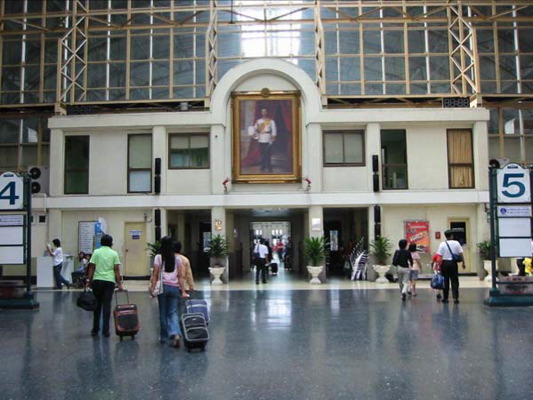
Bangkok Train Station by Tony Wheeler

Tony Wheeler may be the world's most successful publisher of travel guidebooks, but he (sometimes) travels like every other poor schmuck in the world, by train, bus, and songtao across the border from Thailand into Cambodia. His recent travel story at the link.

Tony Wheeler: Singapore to Shanghai

Lonely Planet co-founder Tony Wheeler is on his way to a travel conference in Macau. He could just fly there, but where's the adventure in that? He's decided to don his backpack and travel overland from Singapore to Macau, and then head on to Shanghai after the conference.

This trip will be not too fast, not too slow, not too cheap, not too expensive. He's not doing much preplanning: he's got a visa for China already, but he'll sort out travel, hotels and other visas as he goes. He'll try and stop somewhere interesting every night, and schedule in enough time to look around - and to eat well, of course!

Tony Wheeler Travels Singapore to Shanghai

Chủ Nhật, 2 tháng 10, 2005

100 Words Per Day


Animusic

This is a very clever site that encourages you to write exactly 100 words per day. Click on the text to move to the next page.

100 Words Link