Thứ Hai, 28 tháng 2, 2005

Fantasy and Sci Fi Writers Advances


Famous Fantasy Writer

Somebody recently posted what appears to be a fairly accurate survey of the advances given to fantasy and science fiction writers, and then has a quick look at possible annual incomes. Seems that slightly over 50% pf the writers in these two fields actually make a living from their craft, which must be far superior to travel writers, of which I would guess that less than 10% can pay their bills with their efforts.

How much does a science fiction or fantasy writer make?
01/03/2005
Source: Tobias S. Buckell


Several weeks ago I announced that I would be collecting data on genre advances to grab a snapshot of the field. I'd hoped we could get some better data for conversations. I posted a form online with a series of questions that I hoped would allow us to gather some basic data with which we could learn something together.

Size of Sample Group:

So far 74 writers responded, and since the responses have slowed down, I thought it was time to gather the data and present the results as best I could for what has been gathered so far, and address some of the initial concerns and criticisms I've received via email about this little project. 3 of the writers who responded were 'of genre' but had published outside of the SF/F/H I was looking at, so I have removed their contributions for now.

Summary:

The typical advance for a first novel is $5000. The typical advance for later novels, after a typical number of 5-7 years and 5-7 books is $12,500. Having an agent at any point increases your advance. There is some slight correlation between number of books and number of years spent writing as represented in the 5-12.5 thousand dollar advance shift of an average of 5-7 years. Charting individual author's progressions, which I will not release to keep anonymity, reveals a large number of upward lines at varying degrees of steepness for advances, some downward slides. Some authors noted that they'd gotten large advances in the 90s but were being paid less now
.
Read the Rest

Thứ Tư, 23 tháng 2, 2005

Bob Bone Remembers Hunter


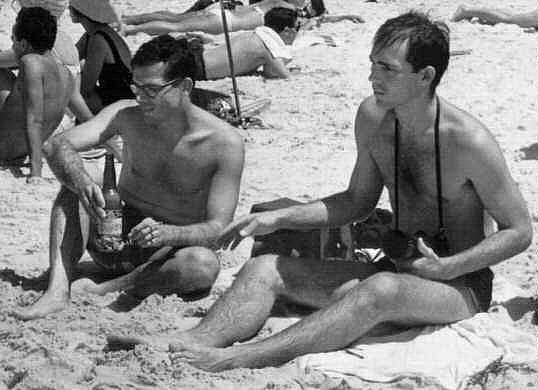
Bob Bone and Hunter, Rio, 1963


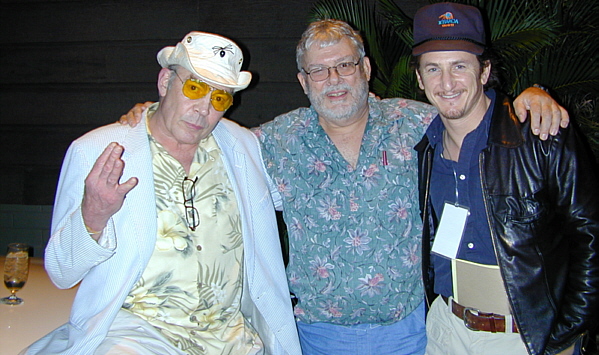
Hunter, Bob Bone, Sean Penn, Honolulu 2001

Bob Bone is a newspaper journalist, magazine columnist, and guidebook author who lives in Hawaii and is a fellow member of the Society of American Travel Writers. He's also an old friend of Hunter S. Thompson, and today he posted a most heartfelt and revealing profile of his early days with Hunter, which I have posted here with his permission.

The writer is the Faust of modern society, the only surviving individualist in a mass age. To his orthodox contemporaries he seems a semi-madman. -- Boris Pasternak

I was shocked -- but not surprised -- to hear of Hunter's death. It was completely consistent with his approach to life.

During the 1960s, when Thompson and I were first trying to make an indelible mark on the world at large, if I had said to him, "Hunter, you're going to kill yourself some day," I'll bet he would have puffed on his pipe, nodded and thoughtfully agreed that it was indeed not outside the realm of possibility.

When we first met, in 1958 while we were on the staff of the Middletown, (N.Y.) Daily Record (now the Times-Herald Record), Hunter revered and frequently quoted Ernest Hemingway. If his life were to have any parallels to that of the great author, he would certainly have approved. Hemingway, of course, was obsessed with death and subsequently took his own life with a gun in 1961.

But Hunter, who pretended much of the time to be angry or incensed at the effronteries and absurdities with which he was frequently confronted, was also fun-loving in his own way. He set up amusing situations -- usually ones which embarrassed those of lesser intellect, but fascinated and delighted others. He often related stories of his conflicts with his superiors in the air force. One later account, which involved himself and a friend getting in a fight in a New York bar, had as its central theme the fact that they both just happened to be carrying bags of flour or cement (I forget which). Of course the bags eventually broke causing havoc on the premises, at the same time that it obscured their escape.

In those days of his relative obscurity, he was often a character of apparent annoyance, but enjoyable enough to be suffered by his friends in spite of it. He was usually broke, but he carried printed personalized checks from an expired bank account in his pocket. If you asked him if could now pay back the 20 bucks you lent him last week, he would reply with a sardonic smile and say, "Of course. I can give you a check!"

I always turned down those worthless checks, but I wish now I had not.

Hunter didn't last long at the Middletown Record. He was already skating on thin ice since he refused to wear shoes while in the news room. But one day, he had an argument with a candy machine. When Hunter lost his two nickels without receiving his due reward, he beat the machine savagely until it disgorged all of its contents. Hunter strolled away carrying only the candy bar that he had paid for. But management soon discovered that everyone in the newsroom and the back shop all were eating candy bars, and so Hunter was discharged. It was certainly just the outcome that he wanted.

Hunter followed me to Puerto Rico. I worked on the first staff of the San Juan Star, a new English-language daily. Hunter worked briefly for an ill-fated local sports magazine. The Star knew better than to hire him, but its managing editor, William Kennedy, and Hunter began a life-long friendship. Kennedy later went on to fame as the author of Ironweed and other novels. In Puerto Rico, Hunter lived in a small community which he claimed was the haunt of witch doctors and other practitioners of voodoo. There he wrote his first novel, the Rum Diary, which ironically was not published until 1998 -- long after his later successes.

The early-60s found us both in Manhattan. Many of our small group of wannabes were at various times resident of a single modest tenement apartment in Greenwich Village. The official tenant was Sandy Conklin, who later became Hunter's first wife. We made beer in the kitchen, and most of us tried to write, with greater or lesser degrees of success. I still have tape recordings of some of our conversations. In 1961, Hunter left for South America. His letters to me contained words and terms which are now famous -- his "gonzo" approach to journalism and to life.

In 1962, I left my job at Popular Photography to edit a small business magazine in Brazil. A few months later, Hunter showed up on Copacabana Beach. I spotted him while riding in a convertible with a friend, and we stopped to let him in the car. He had a drunk monkey in his jacket pocket. His explanation was that he met someone in a bar who would buy him a drink only if he could buy the monkey a drink at the same time. The monkey eventually committed suicide, leaping into the air from the balcony of my tenth-floor apartment -- we presumed a victim of the DTs.

Back in his hotel room Hunter also had a coatamundi, a small furry animal that he said he had rescued from some who were mistreating it in Bolivia. The coatimundi distinguished itself by eventually becoming toilet trained. It also liked to play with soap, thus apparently washing its hands. Hunter named it "Ace."

We had several adventures together in Brazil before we both left within a few months of each other in 1963, Hunter to California and I back to the same traditional Village apartment in New York, and I began working for the New York Post and then for Time-Life. We had considerable correspondence during that period, and occasional meetings on both the West and East coasts. We sought advice from each other on the crises that young men have, but I suppose we seldom followed any of our words of wisdom. I still have many of these letters, whose acerbic terminology presaged those of his later public persona. I even have a Hunter Thompson cartoon which he drew. It's still pinned on the wall above my computer in Hawaii. Not many knew that Hunter could draw a little, too.

After Hunter's first major literary success, his saga on the Hells Angels motorcycle gang, we seldom saw each other again. I married, had a child, and moved to Spain. He promised to follow me, but never did. Hunter married Sandy, and he also had a child, and he moved to Woody Creek, Colorado. He began moving in circles vastly different than my own, although we never completely lost touch. My family and I moved here to Hawaii in 1971, where I began writing a series of travel guidebooks. But if my phone rang in the middle of the night over the past 34 years, it was most likely Hunter.

Every now and then, a mutual acquaintance would mention my name to Hunter. He almost invariably mumbled something like, "Ah, yes. Bone. A good man, Bone." Actually, he regarded me as somewhat intellectually challenged in comparison to himself, and I'm sure he was right.

We last met in person when he came in 2001 to cover the Honolulu Marathon for ESPN.com. It was not entirely a satisfactory meeting. He seemed not much more than a shell of the vigorous and vital friend that I knew nearly a half-century ago. Hunter's body had been taking a beating from his lifestyle for a long time, and I asked him if he realized that he could hardly sit down without slightly rocking back and forth for several minutes afterward. Nevertheless, I felt encouraged by the fact that he still seemed to be hanging in there in spite of it all.

I was never one of Hunter's legions of fans, but I was proud to be one of his good friends, blessed with shared and very fond memories of some of the best days of our lives. I will miss him and his 3 a.m. phone calls.

Robert Bone Travel Writer

Chủ Nhật, 20 tháng 2, 2005

Vagabonding at its Finest


Balinese Children by Carl Parkes

Ever wanted to quit your job and hit the road for a few years, but also do something worthwhile to satisfy your soul and help improve the world's situation? Looks like this young lady from Silicon Valley has found the perfect combination of travel and good deeds.

After I completed and received my degree from Santa Clara University in the Silicon Valley, I moved to San Diego, found a job in an office tower and put nothing less than every drop of my passion into it. I worked 80-hour weeks, slept under my desk on weekends, and quickly became one of the highest paid employees in the company. But after two years of this life, I sat up from my computer one day and realized this; I had a successful job with prestige, an apartment by the beach, a nice car, a pretty boyfriend, and an income greater than that of my parents combined…and it wasn’t enough. Or rather it was enough. It was too much. I was grasping at the wrong dream, desperately clenching onto the airy and materialistic notions of a magazine dream, instead of picking myself up and pursuing my own.

And that’s how I learned that sometimes we spend a lot of lives learning not what we want to do, but what we do not want to do. And that’s okay. It’s not important how many mistakes we make, only that we learn from those we do.

So where was I to go? I had no idea. But on an intuitive whim, I caught a clue as to where I could go to find MY dream. So I sold everything I owned, strapped on a backpack and left the country...

I spent the next four years travelling over six continents and through forty-something countries: working with the children living in the squatter community in the dumpster of Guatemala, building houses for Habitat for Humanity in Fijian villages, strolling the beaches of Costa Rica at midnight keeping the eggs of Leatherback turtles safe from poachers, fighting off Lantana from overtaking the native plant species of Eastern Australia, giving daily massages to the crippled limbs of those left at the Mother Teresa House of the Destitute, preparing the gardens for feeding an orphanage in India, teaching English to refugee monks who escaped from Tibet, and, most recently, planting trees in a reforestation effort in Coastal Ecuador.

Over the course of those years, attending the prestigious "University of Life," I found my path and my passion in "service learning" and in what Dragons calls in its mission statement, "experiential education," which simply means -- using the world as our living classroom and our real experiences and interactions within it as the lesson plan.

So having found my own life-driving inspiration abroad, I quickly realized that the only thing that matched my excitement in making my own reality-quaking revelations was watching, guiding, and sharing that process of "travel-induced-enlightenments" with others -- specifically, with young, enthusiastic and inspired people like you!

Read Her Blog

Thứ Sáu, 18 tháng 2, 2005

Time Out Guides Gets Punk'd


Slate

I'm no expert on Time Out Guides, as they don't produce any guidebooks to Southeast Asia, but I've glanced at their other titles and admired the slick looks and high production values. I've also used their regional weekly publications to find out what's happening in places like New York City, and always got a kick out of their snarky, collegiate level humor. Hip, cool, always in the know.

But this style of always being the "insider" and "cooler than anyone else" doesn't translate well into guidebooks, as pointed out by Slate a few months ago. Thanks Rolf, for reminding me about this amusing and insightful article before it disappears into oblivion.

A few snippets:

Anyone who has used the excellent weekly Time Out guides to London or New York is familiar with their self-consciously savvy voice. It works beautifully for reviewing new bars. It's utterly grating when describing 15th-century architecture.

Rather, my Time Out destination guide was written by and for people who think the optimal amount to know about anything is a little. Knowing nothing is bad, because it shows. But knowing too much about one thing is bad too, because it takes up brain space you could devote to shallower things, like the names of all the nominees in the lesser Oscar categories. The Time Out mind-set is all about achieving a vast, shallow pool of knowledge.

Personally, though, I'll take my information without the snarky bells and whistles. In traveling, I don't want to be counseled on what to enjoy. I cling to the hope that visiting a new place can be about more than what's hot and what's not; that I can still do a few things without mediation. After all, I travel partly to escape the sort of place where knowing the names of obscure bands has become a substitute for enjoying music, and getting into the newest restaurant a stand-in for appreciating food.

Read the Rest

Thứ Hai, 14 tháng 2, 2005

Travel and Leisure Blog Links


Travel and Leisure

Nothing Earth shattering here, but TL has just published a short collection of travel blogs, with a fine mention for WorldHum and BootsnAll.

A new blog may be born every 7.4 minutes, according to search engine Technorati, but which travel blogs are actually worth reading? The best on-line travel diaries include a mix of tips, breaking news, and (of course) juicy personal tidbits. In the end, that's what reading someone else's journal is all about. Here, a few of our favorites.

BootsnAll www.bootblog.com

BEST FEATURES Writing is superior: this is a highly literate collection of travel journals. Members are generally responsive, creating a "classic" blog community feel. Insiders in more than 100 countries are available to answer trip-planning questions.

CAVEAT No mapping function, and you must bookmark the site; postings take you outside it.

Fodor's www.fodors.com/blog

BEST FEATURES Written by Fodor's editors. Offers updated guidebook entries and news. Many useful links to other travel sites, including restaurant blogs, search engines, and in-flight mags.

CAVEAT Organized only by date. Search function scans the entire Fodor's site, not just the blogs.

IgoUgo www.igougo.com

BEST FEATURES One of the largest on-line travel communities (350,000 members and 4,000 destinations at last count). Entries are organized and searchable by destination, interest, member, or keyword. Won a Webby for best travel site.

CAVEAT Though editors post their picks, the huge number of member blogs makes it hard to sort through them.

VirtualTourist www.virtualtourist.com

BEST FEATURES Great for those seeking practical advice; newest entries are organized into categories—tip, discussion, and comment. Othersections include "off the beaten path," "warnings or dangers," and "members living here."

CAVEAT Ads on the site are nearly indistinguishable from content.

World Hum www.worldhum.com

BEST FEATURES More like an on-line travel magazine. Writers submit stories, which are then vetted by the editors. No "What I did on my summer vacation" reports. A comprehensive list of links to newspaper travel sections and travel bookstores.

CAVEAT No search function: stories are organized by date only.

Read the Rest -- with Hot Links