Thứ Tư, 30 tháng 3, 2005

Jim Benning Interviews Don George


Nicole

A few years ago, Jim Benning of WorldHum fame interviewed the former travel editor at the San Francisco Examiner. The review has largely been lost in cyberspace, so I'll post it below for your inspection, as it seems timely with the recent release of a new book by Don George, published by Lonely Planet. It's a book about travel writing, and the first book ever written by Don George.

Don George is one of the most successful travel writers in the country, and has promoted an inspiring viewpoint about the wonders and benefits of travel writing for many, many years: Travel broadens our view of the world, tears down walls, increases understanding, brings peace. Arthur Frommer said it first, but Don has carried on the message for many years, and for this, god bless his soul.

Soul-Stretching Adventures Don't Sell Ads
A conversation with Don George of LonelyPlanet.com
Jim Benning
posted: 2001-05-29
modified: 2002-07-15

In founding Salon's travel section, Wanderlust, in 1997, Don George created a home for the Web's most ambitious literary travel writing. The section featured contributions from writers such as Pico Iyer and Jan Morris, and memorable stories from up-and-coming writers. Quality, however, doesn't ensure longevity, especially online.

Last year, citing money woes and disappointing traffic figures, the online magazine closed the travel section, leaving George out in the San Francisco cold, looking for work.

After a brief stint at Yahoo, George recently landed an editing job at Lonely Planet. The company publishes guidebooks revered by world travelers. It also maintains a thriving Web site. We asked George recently about Salon, the state of online travel journalism and his new gig.

Much has happened since we last talked. What are your thoughts on Salon these days? Are you optimistic about its future?

How can I put this? (Pause.) Salon is facing the greatest challenge of its life, and that's surviving this downturn when advertising all over the Internet has fallen off sharply. What I want to believe is that quality will triumph in the end and that Salon, because it's so great editorially, will pull through. There will come a time when advertising rebounds. I just hope Salon will be around to benefit from that.

How did the closing of the travel section affect your feelings about the future of great online travel writing?

(Sigh.) I felt that if the kind of travel journalism I felt passionately about was going to survive anywhere online, it would have been at Salon. Everybody's hearts and minds were in the right place with what I was doing with Wanderlust. I was tremendously disappointed when it didn't make it. I feel that a purely literary travel site would be almost impossible to make a go of online. What you have to do, I think, is either marry great travel editorial to a site making money some other way, like perhaps a Travelocity or an Expedia, or you have to become the electronic branch of a tree that already has very deep roots in some other medium. That's where Lonely Planet comes in.

After the section closed, where did you look for work?

I talked to online people who fell into two camps. I talked to small, enthusiastic start-ups, which were spiritually wonderful and tempting but didn't offer the kind of stability I wanted. I've had enough of that wild ride already. And then there were the Yahoos and the Travelocitys. I was actually affiliated with Yahoo for a while. That was an exciting opportunity to try to create some original travel editorial content for them, but it ended up not working out. We both saw some great potential there, but as the Internet evolved and Yahoo's concept of editorial offerings evolved, it didn't seem to make as much sense as it originally had.

Did you talk to print magazines, too?

Yeah. I talked to a lot of magazines. I went to New York and Washington and spoke with many editors, and I just came away thinking that there weren't any positions available that were perfect for me. I was looking for something that would allow me to stay on the West Coast and still have a full-time staff job that would involve writing and editing. While there was a lot of interest from people at some of the magazines and from me, this has been a tough time for the magazines. They're not expanding. The kind of job that might appear attractive to them in an age of expansion, such as a West Coast editor, isn't compelling in a time of cutbacks.

I don't see a lot of great travel writing being done at magazines anyway these days. Can a magazine that focuses on literary travel writing even survive?

I think it could survive but not thrive. The kind of great story-telling that Salon majored in is not a core part of any magazine out there now, probably because most of the editors-in-chief look at the bottom line. Tales of unforgettable encounters and soul-stretching adventures don't sell ads as well as tales of glitzy hotels and high-priced restaurants.

That's disappointing.

Yeah, it is disappointing. It doesn't mean that the editors' hearts aren't in the right places, but they have to be quite practical about what their jobs are, and that's to keep the magazines profitable. That said, there is great writing out there. Some of the adventure-oriented magazines like Outside and National Geographic Adventure publish in each issue at least one great read. It's not that the well is dry, it's just that the well is low.

That's so strange, because never before have there been so many travel narrative books being published. Books by Paul Theroux and Bill Bryson. Anthologies. There's a market for this style of writing. The book publishers see it. You'd think magazines would find a way to tap into that.

That's a really interesting point. People's mind-sets when they sit down to read a book might be different than when they pick up a glossy magazine. Hmmm. I wrestle with this stuff all the time. I don't lie awake at night and think, why didn't Wanderlust succeed? But I thought I was doing exactly what I wanted to do and I had a vision of what that was. You can say the Web is a new medium and advertising models weren't sophisticated and that, had it had two or three more years, it might have made it. But none of the print magazines are like that. Is there something else here, that a combination of great tales isn't economically viable? I don't know.

Related to all this, of course, is that last year Villard published a collection of Salon travel stories in a book titled Salon.com's Wanderlust. Has the book done well?

The book has done very well. The initial run was 15,500 copies, and when I was in New York a few months ago, they had sold about 10,500. I assume that a few thousand more have been sold since then, so it's probably on the cusp of another printing. It was on the Los Angeles Times Bestseller List a couple of weeks ago, and I was really shocked. That was very exciting.

How did you wind up at Lonely Planet?

I realized that right in my backyard was Lonely Planet, literally 12 minutes from my home. I've always loved Lonely Planet, ever since I got my first guidebook 20 years ago. It's a publisher I respect immensely, with a huge range of titles, and happily, they had a Web site and a literary travel books series. I've known the founders for 15 years. It hit me that this is a company that I should be looking into. So I did. We were able to craft a job description that seemed to be exactly what all of us were looking for. I officially joined the company March 12. It's like a dream come true.

Was it important that the company was rooted in the print business?

Yes. Lonely Planet's headquarters in Oakland is in a warehouse. When I walked in and saw stacks and stacks of books, that was a really good feeling for me. It was something really palpable that the company was based on.

What exactly do you do?

My title is travel editor. My mission basically falls into three areas. The first involves the Web site. I'm writing a weekly column, already launched, called Traveller at Large. Over time I'm going to be working with other members of the e-team, the people who put together the Web site and wireless stuff. I'll be working with them to develop more robust original content down the road.

Does that mean we might see Wanderlust-style travel stories on the site someday?

It means that portions of something like Wanderlust will resurface down the road. Lonely Planet is trying to prioritize and strategize and figure out what the role of the Web site is in the context of the whole company. The notion of Wanderlust-type content is very much a part of the ongoing conversation.

The Web site has a lot of great components, including the news section.

Yes, that's called Scoop. It's updated every day with about four or five very interesting news stories from around the world. They're these vignettes that teach you something about the countries where they take place.

How about your other roles?

I'm involved with their travel literature books series, called Journeys. I'll be helping to bring in new writers for that. Lastly, we want to create something called Lonely Planet Conversations, which would be me interviewing great travel writers and travelers. We'd excerpt the interviews online in text, and eventually with sound and video clips. We also hope to try to syndicate the interviews either to radio stations, maybe PBS, and or to other TV stations. We'll be filming and recording these interviews for multiple uses. We'll get started in the next few months.

You've got a lot going on.

I've got a lot of plates, and they're all filling up rapidly. But it just feels perfect to me because I didn't want to turn my back on the Internet. I'd invested a lot of my passion and energy into understanding the medium, so I didn't want to just get out of it altogether. This job is so wonderful because it combines the print background I had before Salon (as travel editor of the San Francisco Examiner) with the online background I've gained at Salon. And as for the interviews, I did interviews at the Examiner for my column. That's when I first met people like Pico Iyer and Paul Theroux. So it all feels like it's coming together.

Are you still traveling much?

Happily, yes. Last fall I went to London and I did a cruise in the Mediterranean that began in Venice and ended in Rome and took me to Croatia and Greece. I'm going to Australia in a week and a half, and then I have trips planned for the summer.

Ever get tired of it?

Never. What I have not liked in the past is business travel. When I was at Salon I flew to Paris for a conference and spent the entire time going to meetings, giving speeches. I looked longingly out the taxi window and wanted to claw my way out. Business travel can be anti-travel. You go to an exotic place, but you never get to really be there. But pure travel, that feeling is still there. Being at Lonely Planet feeds that feeling so much. Lonely Planet is completely about the wonder of travel.


Don George Interview about Travel at Slate

Pearls Before Swine


Card Shark Jen Leo

Jen Leo is a sweet, young lady who has worked at Travelers Tales for many years, editing several books and contributing some of her own writing. She also has her own travel blog and is planning a move to Vegas, to keep up with her new blog about gambling. In the meantime, Jen posted some great cartoon links about book signings, guaranteed to amuse all guidebook authors.

Pearls Before Swine on Book Signings

I like Pearls Before Swine by Stephan Pastis. This week they did some strips on book signings.

March 21: Goat and Zebra talk about Rat's new book,

Dickie the Cockroach
.

March 22: Rat's booksigning

March 23: Rat defines comic strips to someone at his author event

March 24: Stephan Pastis attends Rat's signing.

March 25: End of the book signing


Jen Leo and Written Road

More Good News for Writers


Gates Food in Central Park

This announcement has been five or six years in the making. After the issue went to mediation it seemed stuck. Writers whose work was used online without permission are entitled to compensation. Now to plow through the fine print and the red tape.

Dear ASJA Member:

The following press release was just sent out by the three major writers' organizations to the media. Please feel free to circulate it to any and all writers and writers organizations.

Brett Harvey Executive Director

******************************************

$18 Million Settlement to Freelance Writers Filed for Court Approval

Contact: Jim Morrison, American Society of Journalists & Authors,757-451-2434 or jimmor@aol.com Kay Murray, The Authors Guild, 212-563-5904 or kmurray@authorsguild.org Gerard Colby, National Writers Union, 212-254-0279 or GColbyVT@aol.com

New York, March 29 - The American Society of Journalists and Authors, the Authors Guild, and the National Writers Union today announced the filing of a motion for court approval of an $18 million settlement in a class action suit they and 21 freelance writers filed on behalf of thousands of freelance writers whose stories appeared in online databases without their consent. They expect preliminary court approval of the settlement within the next month.

'We are delighted,' said Nick Taylor, president of the Authors Guild. 'This is a substantial settlement, and, if approved, it will vindicate freelance writers who deserve compensation and control for their work in the electronic marketplace. It proves our contention all along that access and online advertising revenues shouldn't all go into the pockets of big media, but should be shared with the creators.'

'ASJA has long preached to freelancers that they demand extra pay for extra uses,' said Jim Morrison, ASJA's president from 2001 to 2003 and the organization's representative in the settlement negotiations. 'Today, we have an $18 million validation of how valuable electronic rights are to publishers. Freelance writers should remember that when negotiating their contracts.'

Gerard Colby, president of the National Writers Union, noted that in its historic 2001 ruling in Tasini vs. New York Times, the Supreme Court ruled that the principles of copyright apply to online distribution of editorial content, and that articles cannot be distributed in cyberspace without permission of their creators. The Tasini litigation was initiated by the NWU and funded in part by its parent union, the United Auto Workers.

'This settlement will put money in writers' pockets,' Colby said. 'Individual awards for individual articles could add up to big money for writers who had more than one article published electronically without their consent, and who take action to file proper claims. This settlement underscores the fundamental importance of the Constitution's copyright clause and proclaims that the rights of writers and artists to own their own creations and to earn a living from them must be respected -- even by the nation's most powerful media corporations.'

'This monetary settlement is the final chapter in a 12-year fight to right a gross injustice,' said Jonathan Tasini, president emeritus of the NWU who served on the settlement negotiating team on behalf of the union. 'But, more important, it shows that writers can stand up, fight and win.'

The filing seeks court approval of a Class Notice, which gives a full description of the benefits of the settlement, identifies which articles are included and which are excluded, and explains authors' rights under the settlement. The settlement is complex, and the three organizations have set up a joint website (www.freelancerights.com) dedicated to helping authors understand the terms and make claims.

Under the terms of the settlement, publishers including the New York Times, Time Inc., and the Wall Street Journal and database companies including Dow Jones Interactive, Knight-Ridder, Lexis-Nexis, Proquest, and West Group agreed to pay writers up to $1,500 for stories in which the writers had registered the copyright in accordance with timetables established in federal copyright law. Writers who failed to register their copyrights will receive up to $60 per article; the organizations believe that many such writers will have valid claims for hundreds of such articles.

The amount paid will depend on a number of factors, including whether the writer registered the copyright, the original fee paid for the article, the year it was published, and whether the writer permits the future use of the article in the databases.

Lisa Collier Cool, current president of the ASJA, urged freelance writers to go online and make their claims when the settlement is approved. Taylor and Morrison noted that fulltime freelancers likely will have substantial numbers of stories eligible for claims. 'I wouldn't be surprised if there are many writers who did not register their copyrights who will earn thousands of dollars from the settlement because they have so many stories eligible for claims,' Morrison said. 'That is why we strongly encourage freelancers to make claims.'

The settlement is filed under In re Literary Works in Electronic Databases Copyright Litigation, MDL No. 1379, in federal court in the Southern District of New York with U.S. District Court Judge George M. Daniels presiding.

### The American Society of Journalists and Authors (www.asja.org) is a trade association of freelance writers founded in 1948 with more than 1,100 members who have met the ASJA's exacting standards of professional achievement.

The Authors Guild (www.authorsguild.org) is the nation's oldest and largest society of published book authors and freelance journalists. The Guild advocates on behalf of its 8,000 members on copyright, contract and free speech matters.

The National Writers Union (www.nwu.org), the nation's only labor union for freelance writers, was founded in 1981. The NWU is Local 1981 of the United Auto Workers. On behalf of its 3,400 members, the NWU advocates for writers rights and fights to improve the income, contracts, and working conditions for all freelance writers including journalists, book authors, business and technical writers, essayists, poets, playwrights, script writers, writers for the web, and campus writers, including instructors and professors.

Good News for Writers


Gates Parody 3

Finally, some good news for writers, including travel writers whose work has been stolen for many years by major corporations and posted on websites littered with banner ads and paid advertising. This scandalous theft has been going on for over a decade, but several writers organizations (ASJA, NWU, AG) have won a fairly large judgment against these thieves.

Many thanks to the groups who filed this lawsuit, but you really wonder: where the hell was the Society of American Travel Writers (SATW)? Scoring their next free press trip for their geriatric freebie loving former travel writers?

***************************

A settlement reached last Wednesday in a class-action online publishing lawsuit could mean plenty of freelance writers will be eligible to receive their share of up to $18 million dollars from big media companies, once the agreement receives court approval that is expected in the next few weeks.

The settlement, which could net qualifying freelancers a collective minimum of $10 million and maximum of $18 million, is the result of a lawsuit meant to remunerate writers for work that had been published over the years in online databases without their approval.

Originally, three separate lawsuits were filed over time, starting in August 2000. They were eventually combined into one large class-action suit. Plaintiffs, who filed on behalf of thousands of freelance writers, included the American Society of Journalists and Authors, the Authors Guild, the National Writers Union and almost two dozen freelance writers.

The suit was filed against several media companies, including Time, Knight Ridder, Reed Elsevier (of which LexisNexis is a division) and The New York Times Company. Under the terms of the settlement, freelance writers who had work published between August 1977 and December 2002 will be eligible to fill out a form -- online or by mail -- that will entitle them to money for works to which they had not signed away their rights to electronic publication, said Jim Morrison, a past president of the American Society of Journalists and Authors who helped negotiate the settlement.

According to a joint press release put out by the American Society of Journalists and Authors, the Authors Guild and the National Writers Union, those eligible could receive up to $1,500 for stories that they had registered a copyright for, or $60 for those they had not. The release said remuneration amounts depend on other things as well, like how much was initially paid for the article when it was published, and if the writer allows future utilization of the article in the databases.

A site called FreelanceRights.com has been set up to help disseminate information about the agreement. Morrison thinks there will be many freelance writers owed money for hundreds of stories. "There will be some freelancers who registered their copyrights who will make six figures under this settlement," he said.

On Tuesday, March 29, a motion was filed for court approval of the settlement. Morrison said a judicial rubber stamp is expected in about a month. A spokesman for Time said, "We think it's a fair resolution to the issues at hand."

Fodor Photography Request?


The Kitty Gates - New York

I'm somewhat skeptical (sceptical?) that the original post is authentic, and that somebody's chain isn't being pulled with this one, but at least it set off some discussion and controvery on one of the travel writers forums.

********************

Here's a message I received via email this morning. I find it a bit insulting that they are not paying photographers. Then again, I wonder if the message is legit.

I am a freelance photo researcher working with Fordor's, gathering images for use in the interiors of the Fodor,s famed Gold Guide travel guides. There is no fee for inclusion in our books, we will give you credit for the images as well as supply you with the travel guide, once it printed. We are looking for either high-resolution digital images or transparencies. Listed below are the images that we are looking for our travel guide book on Mexico, for the section on Mexico City. Please advise if you are able to assist me in locating these images.

Museo de Frida Kahlo, Coyoacan
Museo Casa Estudio Diego Rivera y Frida Kahlo, San Angel
Museo Dolores Olmedo Patiño, Xochimilco
Museo Mural Diego Rivera, Alameda Central

Also photos of both Diego and Frida as well as a few paintings.

Please advise
All the best,

Pam

*******************************************

like the line: "There is no fee for inclusion in our books." That's certainly generous of them. :-)

***************************

Someone will send them photos, a few of which will be included (along with photos, duly licensed and paid for, from more professional photogs), and the free-photo senders will brag that they have their photos in Fodor's, then they will see that having photos in Fodor's doesn't really induce others to pay them big fees for their photos.

Although other publications will be happy to "give them exposure" "at no fee." Actually, I think that what the free-photo people will find is that they are required to sign a contract giving Fodor's universal, eternal, extraterrestrial rights to use the photos however, wherever and whenever they like throughout the universe till the end of time, with or without name credit to the photog.

Non-exclusive rights, of course... :-)

And some people will do it. Why else would the researcher send out such missives, if there were never any responses? Actually, I'd like to see the contract offered to the free-photo people. It might be the ultimate exercise in temerity.

**********************************

As a photographer/travel writer I speak with some reasonableness when I say that this is shocking. How are we to become a profession with professional standards when we are treated as rubes?

What a ridiculous attitude on their part!

*******************************

Seriously folks, how many other professions are treated the way writers/photographers are treated? Some craftspeople are expected to work for the joy or creating and not get paid for their time I guess. Is it only things that are created by machines or computers that are worthy of earning money!!

*************************************

We work in a market economy. If Fodor's can get stuff for free, they will. Heck, if I can get stuff (legally) for free, I will. Zagat has made a good business and useful products with free info. The basis of TripAdvisor's appeal is its free info. Ditto Amazon.com and its product reviews and book lists.

Travel writers are not needed now as much as they once were. Photogs please sit down to receive this: neither are photographers. Digital photography and "darkroom" software has made it much easier for less professional photogs to produce more and better pix, which means that the value of many categories of pix is in decline.

Watch the big phone companies battle one another to the bloody end, while VOIP eats their lunch...with relish. The phone companies and the post office and FedEx got bashed by email. The world owes no one a living. The creative survive.

Think nimble!

*************************************

Thứ Hai, 28 tháng 2, 2005

Fantasy and Sci Fi Writers Advances


Famous Fantasy Writer

Somebody recently posted what appears to be a fairly accurate survey of the advances given to fantasy and science fiction writers, and then has a quick look at possible annual incomes. Seems that slightly over 50% pf the writers in these two fields actually make a living from their craft, which must be far superior to travel writers, of which I would guess that less than 10% can pay their bills with their efforts.

How much does a science fiction or fantasy writer make?
01/03/2005
Source: Tobias S. Buckell


Several weeks ago I announced that I would be collecting data on genre advances to grab a snapshot of the field. I'd hoped we could get some better data for conversations. I posted a form online with a series of questions that I hoped would allow us to gather some basic data with which we could learn something together.

Size of Sample Group:

So far 74 writers responded, and since the responses have slowed down, I thought it was time to gather the data and present the results as best I could for what has been gathered so far, and address some of the initial concerns and criticisms I've received via email about this little project. 3 of the writers who responded were 'of genre' but had published outside of the SF/F/H I was looking at, so I have removed their contributions for now.

Summary:

The typical advance for a first novel is $5000. The typical advance for later novels, after a typical number of 5-7 years and 5-7 books is $12,500. Having an agent at any point increases your advance. There is some slight correlation between number of books and number of years spent writing as represented in the 5-12.5 thousand dollar advance shift of an average of 5-7 years. Charting individual author's progressions, which I will not release to keep anonymity, reveals a large number of upward lines at varying degrees of steepness for advances, some downward slides. Some authors noted that they'd gotten large advances in the 90s but were being paid less now
.
Read the Rest

Thứ Tư, 23 tháng 2, 2005

Bob Bone Remembers Hunter


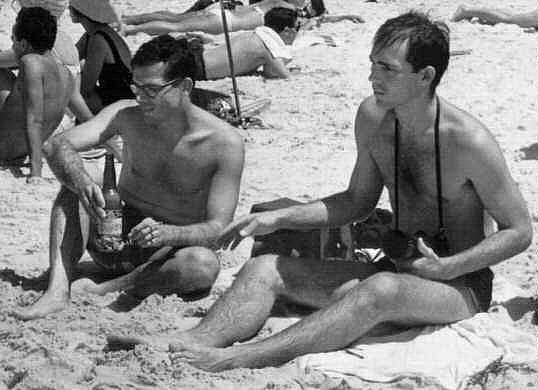
Bob Bone and Hunter, Rio, 1963


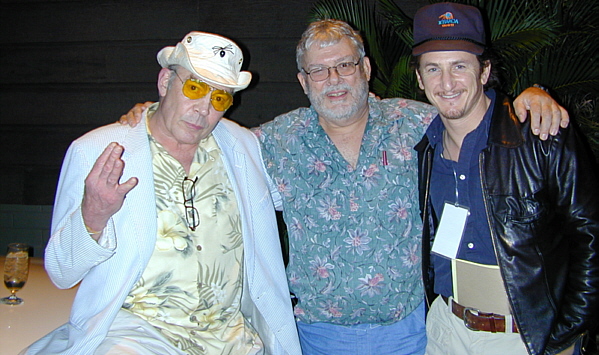
Hunter, Bob Bone, Sean Penn, Honolulu 2001

Bob Bone is a newspaper journalist, magazine columnist, and guidebook author who lives in Hawaii and is a fellow member of the Society of American Travel Writers. He's also an old friend of Hunter S. Thompson, and today he posted a most heartfelt and revealing profile of his early days with Hunter, which I have posted here with his permission.

The writer is the Faust of modern society, the only surviving individualist in a mass age. To his orthodox contemporaries he seems a semi-madman. -- Boris Pasternak

I was shocked -- but not surprised -- to hear of Hunter's death. It was completely consistent with his approach to life.

During the 1960s, when Thompson and I were first trying to make an indelible mark on the world at large, if I had said to him, "Hunter, you're going to kill yourself some day," I'll bet he would have puffed on his pipe, nodded and thoughtfully agreed that it was indeed not outside the realm of possibility.

When we first met, in 1958 while we were on the staff of the Middletown, (N.Y.) Daily Record (now the Times-Herald Record), Hunter revered and frequently quoted Ernest Hemingway. If his life were to have any parallels to that of the great author, he would certainly have approved. Hemingway, of course, was obsessed with death and subsequently took his own life with a gun in 1961.

But Hunter, who pretended much of the time to be angry or incensed at the effronteries and absurdities with which he was frequently confronted, was also fun-loving in his own way. He set up amusing situations -- usually ones which embarrassed those of lesser intellect, but fascinated and delighted others. He often related stories of his conflicts with his superiors in the air force. One later account, which involved himself and a friend getting in a fight in a New York bar, had as its central theme the fact that they both just happened to be carrying bags of flour or cement (I forget which). Of course the bags eventually broke causing havoc on the premises, at the same time that it obscured their escape.

In those days of his relative obscurity, he was often a character of apparent annoyance, but enjoyable enough to be suffered by his friends in spite of it. He was usually broke, but he carried printed personalized checks from an expired bank account in his pocket. If you asked him if could now pay back the 20 bucks you lent him last week, he would reply with a sardonic smile and say, "Of course. I can give you a check!"

I always turned down those worthless checks, but I wish now I had not.

Hunter didn't last long at the Middletown Record. He was already skating on thin ice since he refused to wear shoes while in the news room. But one day, he had an argument with a candy machine. When Hunter lost his two nickels without receiving his due reward, he beat the machine savagely until it disgorged all of its contents. Hunter strolled away carrying only the candy bar that he had paid for. But management soon discovered that everyone in the newsroom and the back shop all were eating candy bars, and so Hunter was discharged. It was certainly just the outcome that he wanted.

Hunter followed me to Puerto Rico. I worked on the first staff of the San Juan Star, a new English-language daily. Hunter worked briefly for an ill-fated local sports magazine. The Star knew better than to hire him, but its managing editor, William Kennedy, and Hunter began a life-long friendship. Kennedy later went on to fame as the author of Ironweed and other novels. In Puerto Rico, Hunter lived in a small community which he claimed was the haunt of witch doctors and other practitioners of voodoo. There he wrote his first novel, the Rum Diary, which ironically was not published until 1998 -- long after his later successes.

The early-60s found us both in Manhattan. Many of our small group of wannabes were at various times resident of a single modest tenement apartment in Greenwich Village. The official tenant was Sandy Conklin, who later became Hunter's first wife. We made beer in the kitchen, and most of us tried to write, with greater or lesser degrees of success. I still have tape recordings of some of our conversations. In 1961, Hunter left for South America. His letters to me contained words and terms which are now famous -- his "gonzo" approach to journalism and to life.

In 1962, I left my job at Popular Photography to edit a small business magazine in Brazil. A few months later, Hunter showed up on Copacabana Beach. I spotted him while riding in a convertible with a friend, and we stopped to let him in the car. He had a drunk monkey in his jacket pocket. His explanation was that he met someone in a bar who would buy him a drink only if he could buy the monkey a drink at the same time. The monkey eventually committed suicide, leaping into the air from the balcony of my tenth-floor apartment -- we presumed a victim of the DTs.

Back in his hotel room Hunter also had a coatamundi, a small furry animal that he said he had rescued from some who were mistreating it in Bolivia. The coatimundi distinguished itself by eventually becoming toilet trained. It also liked to play with soap, thus apparently washing its hands. Hunter named it "Ace."

We had several adventures together in Brazil before we both left within a few months of each other in 1963, Hunter to California and I back to the same traditional Village apartment in New York, and I began working for the New York Post and then for Time-Life. We had considerable correspondence during that period, and occasional meetings on both the West and East coasts. We sought advice from each other on the crises that young men have, but I suppose we seldom followed any of our words of wisdom. I still have many of these letters, whose acerbic terminology presaged those of his later public persona. I even have a Hunter Thompson cartoon which he drew. It's still pinned on the wall above my computer in Hawaii. Not many knew that Hunter could draw a little, too.

After Hunter's first major literary success, his saga on the Hells Angels motorcycle gang, we seldom saw each other again. I married, had a child, and moved to Spain. He promised to follow me, but never did. Hunter married Sandy, and he also had a child, and he moved to Woody Creek, Colorado. He began moving in circles vastly different than my own, although we never completely lost touch. My family and I moved here to Hawaii in 1971, where I began writing a series of travel guidebooks. But if my phone rang in the middle of the night over the past 34 years, it was most likely Hunter.

Every now and then, a mutual acquaintance would mention my name to Hunter. He almost invariably mumbled something like, "Ah, yes. Bone. A good man, Bone." Actually, he regarded me as somewhat intellectually challenged in comparison to himself, and I'm sure he was right.

We last met in person when he came in 2001 to cover the Honolulu Marathon for ESPN.com. It was not entirely a satisfactory meeting. He seemed not much more than a shell of the vigorous and vital friend that I knew nearly a half-century ago. Hunter's body had been taking a beating from his lifestyle for a long time, and I asked him if he realized that he could hardly sit down without slightly rocking back and forth for several minutes afterward. Nevertheless, I felt encouraged by the fact that he still seemed to be hanging in there in spite of it all.

I was never one of Hunter's legions of fans, but I was proud to be one of his good friends, blessed with shared and very fond memories of some of the best days of our lives. I will miss him and his 3 a.m. phone calls.

Robert Bone Travel Writer